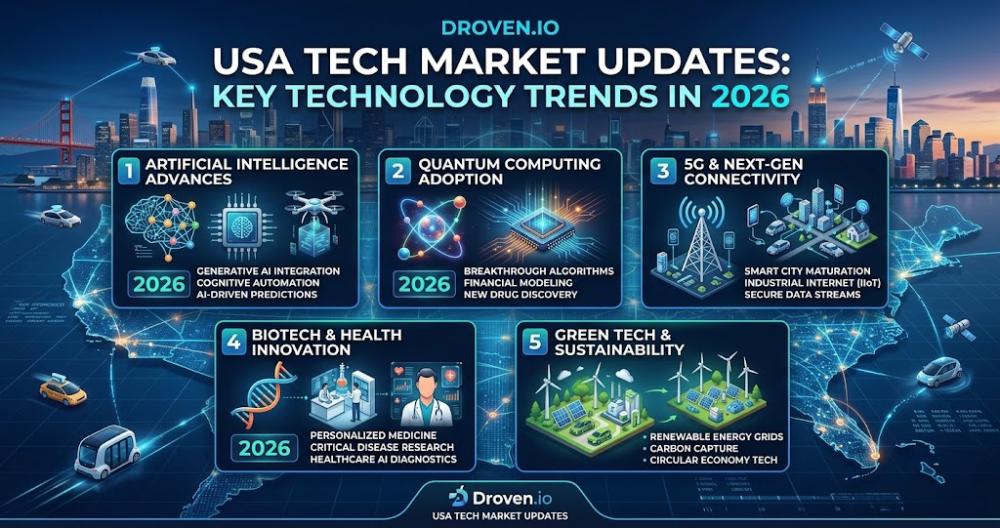
Technology in the United States is moving through another major transformation. Artificial intelligence has moved beyond experimental chatbots, cloud infrastructure is expanding to support increasingly demanding workloads, and semiconductor companies are racing to meet demand from AI data centers. At the same time, cybersecurity, automation, software development, and changing workforce requirements are creating new opportunities and new risks for businesses.
For readers trying to understand these changes, droven.io usa tech market updates provides a useful starting point for following technology news, AI developments, startups, software, and emerging innovation. Droven.io describes itself as an editorial platform covering artificial intelligence, emerging technology, modern business, software development, and future-focused technology topics.
What Are droven.io USA Tech Market Updates?
The phrase droven.io usa tech market updates refers to technology-focused information connected with developments shaping the American digital economy. Instead of looking only at individual gadgets or company announcements, the broader topic includes artificial intelligence, cloud infrastructure, cybersecurity, software development, startups, technology careers, automation, and digital transformation. Droven.io’s technology section specifically highlights U.S. startups, gadgets, Silicon Valley developments, and technologies influencing global innovation.
This broader view matters because technology markets are increasingly interconnected. A breakthrough in AI can increase demand for cloud computing, which increases demand for data centers, networking equipment, semiconductors, power infrastructure, cybersecurity tools, and specialized workers. Understanding one headline therefore requires understanding the ecosystem surrounding it. That is particularly important for founders, developers, technology professionals, investors, students, and business leaders making long-term decisions.
Useful technology market updates should help readers monitor:
- Artificial intelligence and automation
- U.S. technology startups
- Silicon Valley developments
- Cloud computing
- Semiconductors and AI chips
- Cybersecurity
- Enterprise software
- Technology investment
- Digital transformation
- U.S. technology careers
The goal should not be to follow every technology headline. It should be to understand which developments could create meaningful changes in products, businesses, jobs, or consumer behavior.
AI Is Reshaping the U.S. Technology Market
Artificial intelligence remains one of the strongest forces affecting the American technology sector in 2026. Businesses are increasingly interested in AI systems that can complete practical tasks, improve workflows, analyze large datasets, write software, assist employees, and automate repetitive operations. Gartner’s 2026 technology outlook highlights AI-native development platforms and AI computing infrastructure among technologies influencing enterprise strategy.
The market conversation is also changing. Investors are increasingly examining whether enormous AI infrastructure investments can produce sustainable revenue and profits rather than simply rewarding companies for spending aggressively. On August 17, 2026, Reuters reported continued strong cloud demand and persistent capacity constraints while describing growing investor attention to the companies likely to generate durable returns from AI infrastructure.
That transition changes the questions businesses should ask.
Instead of asking only:
- Can we use generative AI?
- Which AI model is newest?
- Which AI tool is trending?
Organizations increasingly need to ask:
- What business problem does the AI system solve?
- How much time or money does it save?
- Can employees reliably use it?
- What data does it require?
- What security risks does it introduce?
- Can the technology scale?
- Does the project create measurable return on investment?
This shift from experimentation toward measurable outcomes is one of the most important AI market trends to watch through droven.io usa tech market updates and other reliable industry sources.
Cloud Computing, Chips, and Data Centers Keep Expanding
AI applications require enormous computing resources. That has strengthened the relationship between artificial intelligence, cloud computing, data centers, networking hardware, and advanced semiconductors. The Semiconductor Industry Association reported in July 2026 that AI infrastructure investment is helping drive extraordinary semiconductor demand, while government and industry investment in AI data-center infrastructure is expected to remain substantial.
Networking companies are benefiting as well. Cisco reported $9.3 billion in AI infrastructure orders during its 2026 fiscal year, according to Reuters, highlighting how AI spending reaches well beyond GPU manufacturers. Cloud platforms, networking equipment, storage systems, memory, cooling technologies, power infrastructure, and security platforms can all participate in the same investment cycle.
| Technology Segment | Main Growth Driver | What to Watch |
|---|---|---|
| Artificial Intelligence | Enterprise automation | ROI and adoption |
| Cloud Computing | AI workloads | Capacity and pricing |
| Semiconductors | AI data centers | Supply and performance |
| Networking | Data movement | AI cluster expansion |
| Cybersecurity | Growing digital risk | AI-enabled threats |
| Data Centers | Computing demand | Energy and infrastructure |
The challenge is that infrastructure cannot expand infinitely. AI data centers consume significant electricity and require sophisticated cooling, networking, construction, and semiconductor supply chains. This means future technology discussions may increasingly include energy availability, grid capacity, chip supply, data-center locations, and infrastructure efficiency alongside traditional software topics.
For readers following droven.io usa tech market updates, the lesson is simple: AI should be viewed as an ecosystem rather than a single product category.
Startups and Silicon Valley Are Entering a New Phase
Artificial intelligence continues to influence U.S. startup investment, but simply attaching “AI” to a company is becoming less persuasive. Investors increasingly want defensible technology, strong distribution, proprietary data, sustainable unit economics, reliable customer demand, and evidence that an AI product solves an important problem. Application-layer companies therefore face pressure to differentiate themselves as AI capabilities become widely available.
The trend can create both opportunities and risks. Entrepreneurs can build sophisticated products faster using AI-assisted development tools, cloud platforms, APIs, and automation. However, lower development barriers also mean competitors can appear quickly. The strongest startups may increasingly be those with industry knowledge, customer relationships, valuable proprietary workflows, or specialized technology that is difficult to reproduce.
Founders evaluating USA tech trends should monitor several signals:
- Customer acquisition costs
- Recurring revenue
- AI inference costs
- Customer retention
- Gross margins
- Competitive differentiation
- Enterprise adoption
- Funding conditions
- Regulatory developments
- Potential acquisition activity
A technology can attract attention without creating a sustainable company. That distinction is particularly important in fast-moving markets where expectations can rise faster than revenue.
Cybersecurity Is Becoming Part of Every Technology Decision
Every major technology trend creates another security question. Companies adopting AI must consider sensitive data, model access, employee permissions, third-party applications, prompt injection, automated agents, API security, and potential information leakage. Cloud adoption creates similar concerns because critical business information may move across numerous services, devices, networks, applications, and external vendors.
Cybersecurity is therefore shifting from a specialist concern toward a core business requirement. Organizations are adopting AI-assisted security tools while attackers can also use automation and artificial intelligence to improve phishing, reconnaissance, social engineering, and other attacks. That creates a technology race in which both defenders and attackers can become faster and more sophisticated.
U.S. Tech Jobs Are Changing, Not Simply Disappearing
The future of work is another important part of droven.io usa tech market updates. AI can automate specific tasks, but the labor-market impact is more complicated than predictions that technology will simply eliminate technology jobs. The U.S. Bureau of Labor Statistics expects increasing IT and AI adoption to support strong growth in several computer and mathematical occupations. Data scientist employment, for example, is projected to grow 33.5% between 2024 and 2034.
Employer expectations are changing quickly, however. Dice reported that AI-related skill requirements appeared in 79% of U.S. technology job postings in July 2026. The implication is that AI literacy is becoming useful beyond dedicated machine-learning positions. Software developers, analysts, cybersecurity professionals, product managers, marketers, designers, and business specialists may increasingly be expected to understand how AI tools fit into their normal workflows.
| Career Area | Increasingly Valuable Skills |
| Software Development | AI-assisted coding, APIs, cloud |
| Data Science | Machine learning, analytics, AI |
| Cybersecurity | Cloud security, AI security |
| DevOps | Automation, containers, cloud |
| Product Management | AI products, analytics, strategy |
| Business Operations | Workflow automation, AI tools |
Professionals do not necessarily need to become AI researchers. They need enough practical knowledge to identify where the technology improves their work and where human judgment remains necessary.
How to Use droven.io USA Tech Market Updates Effectively
A useful market update should help readers make decisions rather than simply generate excitement. When reading droven.io usa tech market updates, start by separating short-term announcements from structural trends. A new device may attract attention for several days, while changes in AI infrastructure, semiconductor demand, cybersecurity, cloud adoption, or workforce skills can influence businesses for years.
Readers should also compare information across multiple sources before making important financial or strategic decisions. Droven.io can help with discovery and explanations, while primary sources such as company financial reports, government data, regulatory announcements, and industry organizations can provide additional verification. This approach is particularly useful when a technology story contains market forecasts, investment figures, employment statistics, or claims about rapidly changing products.
A simple evaluation framework is:
- Identify the development. What actually changed?
- Measure its importance. Is it a product update or structural shift?
- Find the beneficiaries. Which industries or users gain?
- Consider the risks. What could slow adoption?
- Check supporting evidence. Look beyond one headline.
- Monitor progress. Determine whether adoption continues.
This method turns technology news into usable market intelligence.
Frequently Asked Questions
What are droven.io USA tech market updates?
droven.io usa tech market updates refers to information and analysis surrounding technology developments affecting the United States. Topics can include artificial intelligence, U.S. startups, cloud computing, software development, cybersecurity, emerging technologies, technology jobs, gadgets, Silicon Valley, and digital transformation. Droven.io describes its broader editorial focus as AI, technology, software development, innovation, and the future of work.
What technology trends are important in the USA in 2026?
Major themes include artificial intelligence, agentic AI, AI infrastructure, advanced semiconductors, cloud computing, data-center expansion, cybersecurity, AI-assisted software development, and changing technology skills. AI investment is also increasing demand for networking, computing infrastructure, power, and other technologies that support large-scale AI systems.
Does Droven.io cover artificial intelligence?
Yes. Artificial intelligence is a central topic on Droven.io. The platform describes itself as providing AI information, tools, guides, and future-technology insights while also covering related subjects such as software development, digital transformation, innovation, and modern business.
Which U.S. technology sectors should businesses watch?
AI software, cloud infrastructure, semiconductors, data centers, cybersecurity, enterprise automation, developer tools, and networking deserve attention. Their importance is connected: expanding AI adoption creates additional computing and networking demand while also introducing new security, energy, data-management, and workforce requirements.
How can professionals stay updated on the U.S. technology market?
Professionals should combine technology publications with primary information from companies, government agencies, industry groups, research institutions, and regulatory organizations. Focus on developments that influence customers, skills, costs, business models, or long-term technology adoption rather than trying to follow every product announcement.
Conclusion
The U.S. technology market in 2026 is being shaped by far more than individual AI applications. Artificial intelligence is influencing cloud computing, semiconductors, networking, data centers, cybersecurity, software development, startup investment, and technology careers. Understanding those connections provides a much clearer picture of where the market may be heading.
Following droven.io usa tech market updates can help readers identify important developments and explore emerging technology topics. The strongest approach is to combine timely technology coverage with reliable supporting evidence, practical analysis, and a clear focus on how each trend affects businesses, professionals, developers, and consumers.