Nominal vs effective interest rate is one of the most confusing pairs of terms in personal finance, and for good reason. Banks, lenders, and credit card companies often advertise the nominal rate because it looks smaller and more attractive. The effective rate, however, tells you what you’re really paying or earning once compounding enters the picture. Understanding the gap between the two can save you thousands of dollars over the life of a loan or investment.
In this guide, you’ll learn exactly what each rate means, how to calculate them, and why the difference matters more than most borrowers realize. We’ll walk through real formulas, side-by-side examples, and the mistakes people make when comparing loan or savings offers.
Whether you’re shopping for a mortgage, comparing credit cards, or trying to figure out which savings account will grow your money fastest, this single distinction can change your decision entirely. A rate that looks like the better deal on paper can quietly cost you more once compounding is factored in. By the end of this article, you’ll be able to spot that gap yourself and calculate the true cost or return of any financial product.
What Is a Nominal Interest Rate?
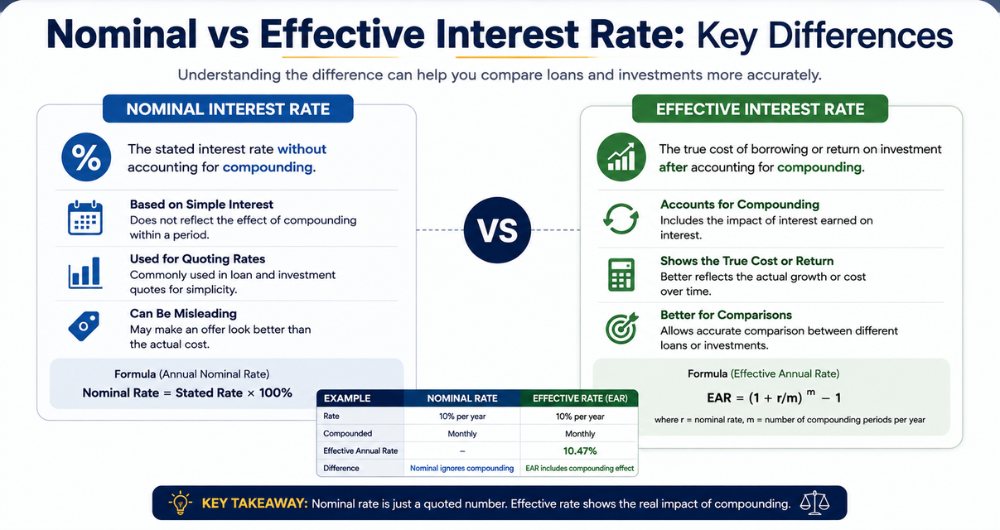
A nominal interest rate is the stated, or advertised, rate on a loan, credit card, or savings account before accounting for compounding within the year. It’s the number you see printed on a bank flyer or listed in a loan agreement. Lenders often quote this figure because it’s simpler to state and usually appears lower than the true cost of borrowing.
For example, a credit card might advertise an 18% nominal annual interest rate. That sounds straightforward, but it doesn’t reflect how often interest compounds. If interest is charged monthly rather than once a year, the actual cost to you is higher than 18%. This is exactly why the nominal vs effective interest rate distinction matters so much for everyday financial decisions.
Nominal rates are useful as a quick reference point, and they’re required in most loan disclosures and marketing materials. However, treating the nominal rate as your final answer can lead to underestimating what you’ll owe on a credit card balance or overestimating what a savings account will pay out. Think of the nominal rate as the headline number, and the effective rate as the fine print that tells the full story.
What Is an Effective Interest Rate?
The effective interest rate, sometimes called the annual equivalent rate, accounts for compounding frequency within a year. It shows the real percentage you pay on a loan or earn on savings after interest has been compounded monthly, quarterly, or daily. Because it captures the compounding effect, the effective rate is almost always higher than the nominal rate whenever compounding occurs more than once a year.
Regulators require lenders to disclose an annual percentage rate (APR) partly to help consumers see past the nominal figure. Still, APR and effective rate aren’t always identical, since APR sometimes excludes certain fees or compounding nuances. Knowing the true effective rate lets you compare loan offers, credit cards, and savings accounts on equal footing, rather than relying on marketing numbers alone.
On the savings side, banks often advertise the annual percentage yield (APY), which is essentially the effective interest rate applied to deposits. A high-yield savings account might list a 4.50% APY built on a slightly lower nominal rate, thanks to daily compounding. Understanding this relationship helps you recognize that APY and effective rate are describing the same underlying concept from a saver’s perspective.
Nominal vs Effective Interest Rate: The Core Difference
The core difference comes down to compounding. Nominal rate ignores how many times interest compounds during the year, treating the rate as if it applies just once. Effective rate incorporates compounding frequency, which means it grows larger as compounding periods increase. Two loans with the same nominal rate can have very different effective rates depending on whether interest compounds annually, monthly, or daily.
This distinction becomes critical when you’re comparing financial products. A savings account compounding daily will earn more than one compounding annually, even if both list the same nominal rate. Likewise, a loan that compounds monthly will cost more in real terms than one compounding yearly. Always check compounding frequency before assuming two offers are equivalent.
| Feature | Nominal Interest Rate | Effective Interest Rate |
|---|---|---|
| Definition | Stated annual rate, no compounding factored in | True annual rate after compounding |
| Also known as | Annual percentage rate (in some contexts) | Annual equivalent rate (AER) |
| Compounding effect | Ignored | Fully included |
| Typical value | Lower number | Higher number (when compounding occurs) |
| Best used for | Quick comparisons, contract wording | Accurate cost or return comparisons |
| Appears on | Loan agreements, ads | APR disclosures, financial calculators |
How to Calculate Effective Interest Rate
Converting a nominal rate into an effective rate requires a straightforward formula. Once you know the nominal rate and the number of compounding periods per year, the math takes only a few steps. This is one of the most searched calculations in personal finance, so it’s worth memorizing.
The formula is:
Effective Rate = (1 + i/n)^n − 1
Where i is the nominal annual interest rate (as a decimal) and n is the number of compounding periods per year.
Follow these steps to calculate it yourself:
- Convert the nominal rate to a decimal (18% becomes 0.18).
- Divide the nominal rate by the number of compounding periods per year.
- Add 1 to that result.
- Raise the result to the power of the number of compounding periods.
- Subtract 1 from the final number.
- Multiply by 100 to express the answer as a percentage.
Example: A loan has an 18% nominal annual rate, compounded monthly (n = 12).
- Step 1: i = 0.18
- Step 2: 0.18 / 12 = 0.015
- Step 3: 1 + 0.015 = 1.015
- Step 4: 1.015^12 ≈ 1.1956
- Step 5: 1.1956 − 1 = 0.1956
- Step 6: 0.1956 × 100 = 19.56%
So an 18% nominal rate compounded monthly actually costs 19.56% per year. That’s the real number you should use when comparing offers, budgeting repayments, or evaluating an investment’s true return.
Why Compounding Frequency Changes Your Real Rate
Compounding frequency is the single biggest factor separating nominal and effective interest rates. The more often interest compounds, the larger the gap becomes between the two figures. This matters whether you’re a borrower trying to minimize cost or a saver trying to maximize returns.
Here’s how a 10% nominal rate behaves under different compounding schedules:
| Compounding Frequency | Periods per Year (n) | Effective Rate |
|---|---|---|
| Annually | 1 | 10.00% |
| Semi-annually | 2 | 10.25% |
| Quarterly | 4 | 10.38% |
| Monthly | 12 | 10.47% |
| Daily | 365 | 10.52% |
As the table shows, the effective rate climbs steadily as compounding periods increase, even though the nominal rate never changes. This is why two accounts advertising the “same” 10% rate can produce noticeably different balances over time, purely because of how often interest compounds.
Nominal vs Effective Rate in Real Life
Understanding these concepts in the abstract is useful, but seeing them applied to everyday financial products makes the difference click. Mortgages, credit cards, and savings accounts all handle compounding differently, and the nominal vs effective interest rate gap shows up in each one in a slightly different way.
Mortgages typically compound monthly, so the effective rate on a home loan is always somewhat higher than the advertised nominal rate. Credit cards often compound daily, which is one reason carrying a balance becomes expensive so quickly. Savings and money market accounts, on the other hand, benefit consumers when compounding happens more frequently, since more frequent compounding means faster growth on deposited funds.
- Mortgages: Compounded monthly; effective rate is slightly above nominal rate.
- Credit cards: Often compounded daily; effective rate can be significantly higher than the advertised APR.
- Savings accounts: Compounded daily or monthly; higher compounding frequency benefits the saver.
- Certificates of deposit (CDs): Compounding terms vary by bank; always check the annual percentage yield (APY), which reflects the effective rate.
- Auto loans: Usually compounded monthly, similar to mortgages in structure.
Nominal vs Effective Rate for Investments and Bonds
Investors run into the nominal vs effective interest rate question just as often as borrowers do, especially when evaluating bonds, certificates of deposit, or fixed-income portfolios. A bond might list a nominal coupon rate, but the actual yield an investor earns depends on how interest payments are reinvested and how often they’re compounded within the year.
This is why financial professionals often talk about “yield to maturity” or “effective annual yield” rather than the coupon rate alone. Two bonds with identical coupon rates can produce different real returns if one pays interest semi-annually and the other pays quarterly. When comparing fixed-income investments, always look past the coupon rate and check how the issuer calculates and pays out interest over the year.
Tips for Comparing Rates When Shopping for a Loan
Shopping around for the best loan or credit product becomes much easier once you know what to look for. A few simple habits can help you avoid being misled by an attractive-looking nominal rate.
- Ask each lender for the effective rate or APR, not just the nominal rate, before comparing offers.
- Request the compounding frequency in writing so you can verify the numbers yourself.
- Use an online effective rate calculator or the formula above to double-check any figures a lender provides.
- Pay attention to origination fees, closing costs, or annual fees, since these can raise your true cost beyond the effective rate alone.
- Compare offers from at least three lenders to get a realistic sense of market rates.
Following these steps takes only a little extra time, but it can meaningfully change which loan or savings product ends up being the smarter choice.
Common Mistakes to Avoid
Many borrowers and savers make avoidable errors when comparing rates, largely because marketing materials emphasize the nominal figure. Recognizing these pitfalls helps you make smarter financial decisions and avoid surprises on your statements.
Use this checklist before signing any loan agreement or opening a savings account:
- Confirm whether the advertised rate is nominal or effective.
- Ask how often interest compounds (daily, monthly, quarterly, annually).
- Compare the APY or effective rate, not just the headline percentage.
- Factor in any fees that might not be included in the nominal rate.
- Recalculate the effective rate yourself if the lender doesn’t disclose it clearly.
- Compare multiple offers using the same compounding basis.
Skipping any of these steps can lead you to underestimate loan costs or overestimate savings growth, both of which affect your long-term financial planning.
Frequently Asked Questions
Is the effective interest rate always higher than the nominal rate?
Yes, whenever compounding occurs more than once per year, the effective rate will be higher than the nominal rate. If compounding happens only once annually, the two rates are equal.
Which rate should I use when comparing loans?
Always compare effective interest rates, or the APR/APY when available, since these reflect the true cost or return after compounding is factored in.
Does APR equal the effective interest rate?
Not always. APR can include certain fees but may not fully capture compounding the way the effective rate does, so it’s worth checking both figures when possible.
How does compounding frequency affect savings accounts?
More frequent compounding, such as daily instead of annually, means your effective rate of return is higher, so your savings grow faster even with the same nominal rate.
Can two loans have the same nominal rate but different real costs?
Yes. If one loan compounds monthly and another compounds quarterly, the loan with more frequent compounding will have a higher effective rate and therefore cost more over time.
Conclusion
The nominal vs effective interest rate comparison ultimately comes down to one factor: compounding. Nominal rates give you a quick, simplified number, while effective rates reveal what you’ll actually pay on a loan or earn on savings. Whenever you’re evaluating a mortgage, credit card, auto loan, or savings account, take the extra minute to calculate or look up the effective rate. That single step can help you avoid costly surprises and make more confident, informed financial decisions.