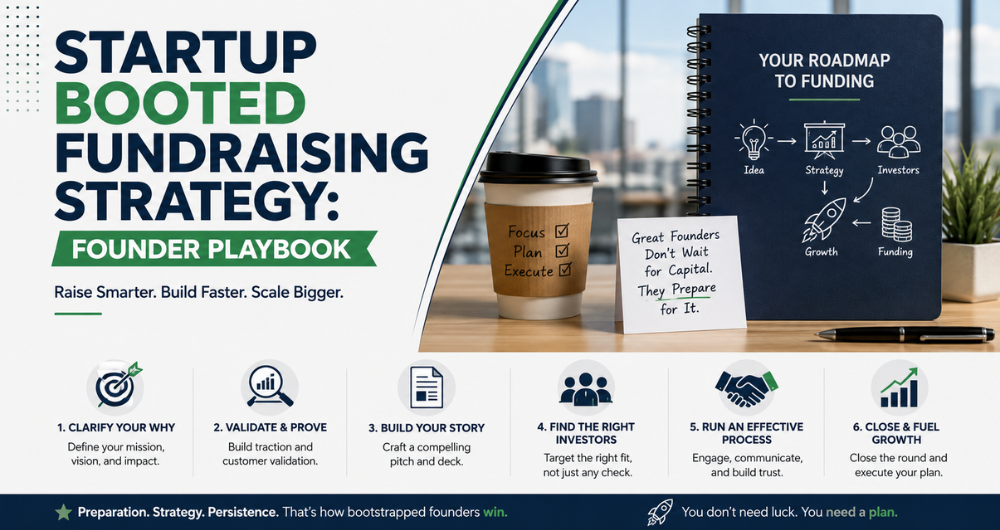
A startup does not necessarily need a large venture capital round to turn an idea into a viable company. Many founders begin with savings, early customer payments, consulting income, pre-orders, or profits generated directly by the business. A startup booted fundraising strategy takes that disciplined approach further by deciding intentionally when internal resources are enough and when outside capital could create significantly more value.
The term “startup booted” is commonly used online as another way of describing a bootstrapped or revenue-first startup. The objective is not simply to avoid investors. It is to create financial leverage before approaching them. Instead of fundraising because the bank account is nearly empty, founders build customers, revenue, operating discipline, and measurable traction first. This can put the company in a stronger position when financing eventually becomes necessary.
What Is a Startup Booted Fundraising Strategy?
A startup booted fundraising strategy is an approach in which founders initially finance growth through their own resources and business-generated cash before relying heavily on external investors. Money may come from savings, customer revenue, pre-sales, retained earnings, or other relatively founder-controlled sources. External funding remains an option, but it is used strategically rather than treated as the automatic first step for building the company.
Bootstrapping should not be confused with refusing capital under every circumstance. A founder may bootstrap the company through product validation, reach meaningful recurring revenue, and later raise an angel or venture round to accelerate a proven opportunity. The real principle is sequencing. Capital should solve a defined growth constraint instead of covering an unclear business model, weak demand, or uncontrolled spending.
Bootstrapping Versus Traditional Venture-First Growth
The two approaches can produce successful companies, but their priorities are different. Venture-first startups commonly exchange equity for capital early to pursue rapid hiring, product development, market expansion, or network effects. Bootstrapped businesses tend to prioritize revenue, margins, operational efficiency, and controlled growth before accepting substantial dilution.
| Factor | Bootstrapped Approach | Venture-First Approach |
|---|---|---|
| Initial capital | Founder funds and revenue | Investor capital |
| Ownership | Founders retain more initially | Equity is sold earlier |
| Growth pace | Usually controlled | Often aggressive |
| Financial pressure | Cash-flow focused | Growth milestone focused |
| Decision control | Higher founder control | Investors may gain influence |
| Main proof point | Customers and revenue | Market opportunity and growth |
| Best suited for | Capital-efficient models | Capital-intensive or fast-moving markets |
Neither model is automatically superior. A software company that can acquire customers inexpensively may have the option to bootstrap for years. A biotechnology company requiring expensive laboratories and regulatory work may need external capital almost immediately. The right funding model should match the economics and competitive realities of the business rather than follow startup culture or investor trends.
Why Revenue-First Growth Can Strengthen a Startup
Customer revenue provides one of the clearest forms of business validation because someone has chosen to pay for the solution. Founders who concentrate on acquiring real customers often discover pricing problems, weak features, onboarding friction, and changing market expectations faster than teams focused mainly on investor presentations. Revenue does not automatically prove product-market fit, but it produces practical evidence that can help founders improve their product and positioning.
Bootstrapping can also create spending discipline. Every software subscription, hire, advertising campaign, and contractor expense competes for limited cash. That constraint encourages founders to measure what actually contributes to growth. When the company eventually approaches investors, a record of responsible capital allocation may make the fundraising story stronger because management can explain exactly how additional money would be deployed.
A revenue-first strategy can strengthen:
- customer understanding
- pricing discipline
- gross margins
- cash-flow awareness
- founder ownership
- operational efficiency
- investor negotiating leverage
- understanding of customer acquisition costs
- confidence in future growth assumptions
A bootstrapped company can still experience financial problems. Growing sales without managing receivables, churn, inventory, payroll, or acquisition costs can create a cash shortage even when reported revenue looks impressive. Founders therefore need to monitor cash as carefully as growth. Sustainable startup growth depends not only on selling more but also on understanding when money enters and leaves the business.
How to Build a Startup Booted Fundraising Strategy
Building a startup booted fundraising strategy starts with understanding how much money the business actually requires. Many founders estimate funding based on ambitious growth plans rather than the minimum resources needed to reach the next meaningful milestone. A better approach is to calculate essential operating expenses, determine monthly burn, estimate available runway, and separate activities that create measurable business value from spending that can wait.
A practical plan should also define the conditions that would justify external fundraising. Rather than saying, “We will raise money when we need it,” establish measurable triggers. Examples might include reaching a specific recurring revenue level, maintaining acceptable customer retention, proving a repeatable acquisition channel, securing enterprise demand that exceeds current capacity, or identifying an expansion opportunity that would be lost without additional capital.
Use this sequence:
- Calculate your real runway. Determine available cash and realistic monthly expenses.
- Validate the problem. Speak directly with prospective customers before building extensively.
- Create the smallest sellable solution. Focus on the feature or service customers will actually pay for.
- Generate revenue early. Use sales to validate demand rather than waiting for a perfect product.
- Track unit economics. Understand margins, acquisition costs, retention, and customer value.
- Reinvest selectively. Put profits into activities capable of generating additional revenue or defensibility.
- Prepare fundraising materials early. Build financial records, metrics, forecasts, and a clear capital plan before approaching investors.
Your fundraising readiness dashboard does not need dozens of metrics. Track numbers that explain whether additional capital is likely to accelerate something already working. A strong pitch becomes easier when founders can connect requested capital directly to measurable outcomes instead of relying on optimistic projections.
| Metric | Why It Matters |
| Monthly revenue | Shows commercial traction |
| Revenue growth | Indicates business momentum |
| Gross margin | Reveals economic quality |
| Cash runway | Shows how long the company can operate |
| Customer retention | Measures ongoing product value |
| Customer acquisition cost | Shows sales efficiency |
| Lifetime value | Helps assess acquisition sustainability |
| Burn rate | Measures monthly cash consumption |
| Conversion rate | Shows sales or funnel effectiveness |
Funding Options for a Bootstrapped Startup
External financing is not one single decision. A company can choose among customer financing, debt, grants, crowdfunding, angel investment, SAFEs, or priced equity rounds depending on its stage and business model. The U.S. Small Business Administration highlights loans, investments, and grants among potential business funding sources and recommends having clear startup-cost and business-planning information when seeking financing.
One of the strongest sources of bootstrapped capital is often the customer. Pre-orders, annual contracts, paid pilots, setup fees, deposits, consulting services, and early-access programs can finance development without selling ownership. This model works best when customers receive genuine value in return and the company can confidently fulfill the commitments it makes.
Comparing Startup Funding Options
| Funding Source | Equity Dilution | Repayment | Best Use |
| Customer revenue | None | No | Sustainable operations |
| Founder savings | None | No | Validation and early launch |
| Grants | Usually none | Usually no | Eligible projects and innovation |
| Business loans | None | Yes | Predictable cash-flow businesses |
| Crowdfunding | Depends on structure | Depends | Products or community-backed ventures |
| Angel investment | Yes | No | Early expansion and expertise |
| SAFE | Future equity conversion | Generally not standard loan repayment | Early-stage investment |
| Venture capital | Yes | No | Aggressive scalable growth |
U.S. securities crowdfunding can also provide outside capital, although founders need to understand the regulatory requirements involved. Under Regulation Crowdfunding, eligible U.S. companies can currently raise up to $5 million during a 12-month period, and transactions must occur through an SEC-registered broker-dealer or funding portal. Founders considering this route should review the SEC requirements and obtain appropriate legal advice before offering securities.
Another common early-stage instrument is a SAFE, or Simple Agreement for Future Equity. Y Combinator describes a SAFE as an agreement through which an investor provides capital that can later convert into company shares according to the agreement’s terms. SAFE structures can simplify early fundraising, but founders still need to understand valuation caps, dilution, conversion mechanics, and the cumulative effect of issuing multiple SAFEs.
When Should a Bootstrapped Startup Raise External Capital?
The best fundraising moment is often when money can accelerate a demonstrated opportunity rather than rescue an unproven business. For example, imagine a SaaS company generating $80,000 in annual recurring revenue with strong retention and a profitable acquisition channel. If hiring two salespeople could expand that channel faster than existing cash allows, outside capital has a clearly defined purpose. Investors can see what works and understand how their money may influence growth.
By contrast, raising money simply because the founders have not discovered how to generate revenue can create additional problems. Capital may extend runway, but it cannot automatically create product-market fit. A startup booted fundraising strategy should therefore distinguish between a capital constraint and a business-model constraint. Funding is most powerful when the company knows what needs to be scaled and has evidence supporting that decision.
Consider raising when:
- customer demand consistently exceeds your capacity
- a proven acquisition channel can be expanded
- product development is limited primarily by available capital
- an important market opportunity has a short window
- enterprise contracts require additional staff or infrastructure
- expansion economics are already reasonably understood
- capital can significantly shorten the path toward a meaningful milestone
Avoid beginning a fundraising process without knowing how much you need, what milestone the money should achieve, and what ownership consequences you are willing to accept. Y Combinator’s seed fundraising guidance likewise emphasizes understanding the fundraising process and how startup financing works before founders begin seeking seed capital.
Conclusion
A successful startup booted fundraising strategy is ultimately about creating options. Founders use revenue, controlled spending, customer validation, and disciplined reinvestment to build a stronger business before depending heavily on investors. Bootstrapping can preserve ownership and encourage efficient operations, while selective external capital can help a company move faster once it has identified a repeatable opportunity worth accelerating.
The goal is not to remain bootstrapped forever or to reject venture capital automatically. It is to make financing serve the company instead of allowing financing to become the company’s primary objective. Understand your economics, know your runway, validate demand, track meaningful metrics, and raise outside capital when you can clearly explain what that money will accomplish.
Frequently Asked Questions
Is bootstrapping the same as never raising money?
No. Bootstrapping describes how a company finances itself during a particular stage, usually through founder resources, operating revenue, or other internally controlled capital. A bootstrapped startup can later raise angel investment, use a SAFE, take debt, pursue crowdfunding, or complete a venture round. Many founders bootstrap specifically so they can reach meaningful milestones before fundraising and approach investors with stronger traction and potentially greater negotiating leverage.
How long should a startup bootstrap before fundraising?
There is no universal number of months or years. Bootstrap until external capital can create more strategic value than the ownership or financial cost required to obtain it. For one startup, that point may arrive before launch because the business requires expensive research or equipment. Another company may remain self-funded indefinitely because customer revenue can finance growth. Milestones and economics are more useful decision criteria than a fixed timeline.
What is the best funding source for a bootstrapped startup?
Customer-generated revenue is attractive because it can finance operations without automatically creating debt or equity dilution. However, it is not always sufficient. Grants may suit eligible innovation projects, loans may suit companies with predictable repayment capacity, and equity financing can suit companies pursuing rapid expansion. The best option is the one whose cost, risk, timing, and obligations match the specific use of capital.
Can bootstrapped startups attract venture capital?
Yes. Bootstrapping can produce several characteristics investors often want to evaluate, including revenue, customer demand, retention, operational knowledge, and evidence that founders can execute with limited resources. However, venture capital investors generally look for opportunities capable of substantial growth, so profitability alone does not guarantee investment. Founders still need to explain market size, competitive advantage, growth potential, team capability, and how investor capital could accelerate the opportunity.
How can founders avoid excessive equity dilution?
Start by understanding the ownership impact of every financing instrument before signing it. Raise an amount connected to a defined milestone instead of automatically taking the largest available round. Model future financing scenarios, option-pool changes, SAFE conversions, and additional rounds using an accurate cap table. Founders should also compare equity financing against revenue, grants, debt, or continued bootstrapping when those alternatives can achieve the same objective with acceptable risk.