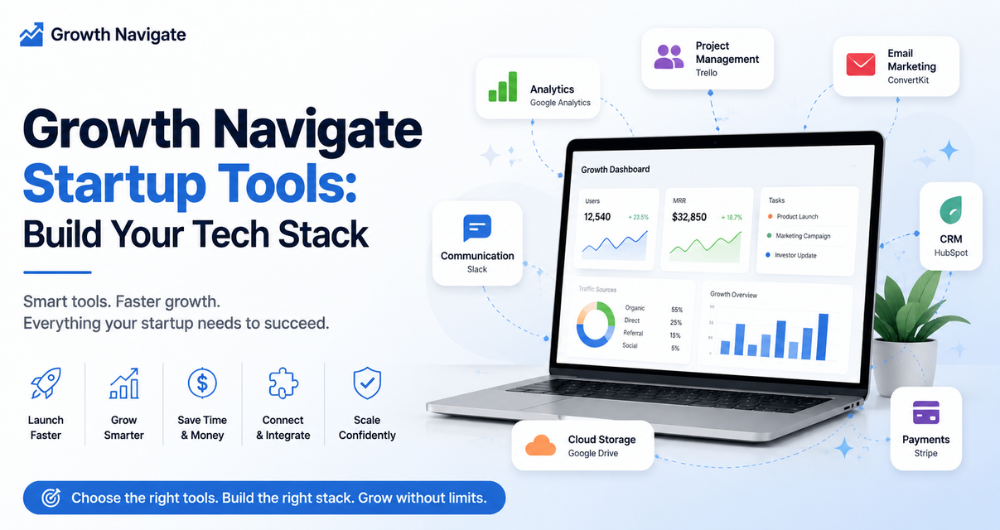
Startup software should make growth easier, not create another layer of work. That is the central idea behind growth navigate startup tools: choosing a focused set of platforms that help a young company attract customers, organize work, manage sales, communicate clearly, and make better decisions. The goal is not to collect popular apps. It is to build a practical system that supports the company at its current stage and can expand when the business becomes more complex.
Search results for this topic show that Growth Navigate itself groups startup tools around jobs such as copywriting, team collaboration, and sales, with examples including Jasper, Copy.ai, Grammarly, Slack, Asana, Miro, Notion, Loom, Zoom, HubSpot, Zoho, and Pipedrive. That makes the intent both navigational and informational: readers want useful software recommendations, but they also need help deciding what belongs in a startup software stack and what can wait.
What Growth Navigate Startup Tools Mean for Founders
Growth navigate startup tools are best understood as a working toolkit for the major jobs inside an early-stage business. A founder may need software for customer relationship management, content production, project management, internal communication, sales pipelines, documentation, analytics, and automation. Each tool should solve a defined operational problem. When software is selected around real needs, the stack becomes easier to use, easier to maintain, and easier to evaluate.
The mistake is assuming that more software automatically creates more capability. Every additional platform adds setup, training, notifications, permissions, subscriptions, and data that may need to move between systems. A lean startup usually benefits more from a few well-connected tools than from a long list of overlapping products. The best startup growth tools reduce friction, create visibility, and help a small team spend more time on customers, product quality, and revenue-producing work.
A useful startup stack usually covers these core needs:
- Team communication and collaboration
- Project and task management
- Customer relationship management
- Marketing and content creation
- Sales pipeline management
- Analytics and reporting
- Workflow automation
- Documentation and knowledge management
How to Choose Startup Tools Without Wasting Budget
Start with the problem, not the brand name. Before adding a platform, write down the task that currently wastes time, causes errors, or prevents the team from seeing important information. A CRM for startups makes sense when leads are being lost in inboxes or spreadsheets. Project management software matters when ownership and deadlines are unclear. Workflow automation becomes valuable when the same information is repeatedly copied between tools or routine steps consume hours every week.
Next, evaluate the total operating cost rather than the advertised entry price. A low-cost tool can become expensive if it requires extra integrations, duplicate subscriptions, extensive onboarding, or manual cleanup. Look at ease of adoption, permissions, integrations, reporting, export options, and how pricing changes as the team grows. A scalable tech stack should be affordable today without forcing a painful migration as soon as the startup adds customers, employees, or more complex processes.
Use this checklist before adding any tool:
- Does it solve a specific, recurring problem?
- Will at least one person own the tool internally?
- Does it integrate with software already in use?
- Can the team export its data if needed?
- Are the reporting features useful for real decisions?
- Can existing software already perform the same job?
- Will the tool still make sense at the next growth stage?
Essential Growth Navigate Startup Tools by Business Function
The Growth Navigate startup-tools page currently highlights software across copywriting, team collaboration, and sales. Its examples include writing tools such as Jasper, Copy.ai, and Grammarly; collaboration platforms such as Slack, Asana, Miro, Notion, Loom, and Zoom; and sales systems such as HubSpot Sales Hub, Zoho, and Pipedrive. That organization is useful because it matches software to a business job instead of treating every startup tool as interchangeable.
Founders can improve on a simple tool list by matching each category to an outcome. Team collaboration tools should reduce coordination delays. Sales tools should make the pipeline easier to track. Marketing automation should help move prospects through repeatable journeys. Startup analytics tools should answer questions about acquisition, activation, retention, and revenue. AI tools for startups can accelerate research or production, but they still need human review, clear workflows, and measurable business value.
| Business Need | Tool Category | Example Tools | Primary Outcome |
|---|---|---|---|
| Organize team knowledge | Workspace/documentation | Notion | Faster access to shared information |
| Coordinate projects | Project management | Asana | Clear ownership and deadlines |
| Communicate internally | Team collaboration | Slack, Loom | Less fragmented communication |
| Manage leads and deals | CRM/sales | HubSpot, Zoho, Pipedrive | Better pipeline visibility |
| Create marketing content | AI/copywriting | Jasper, Copy.ai, Grammarly | Faster content workflows |
| Plan visually | Collaboration/whiteboarding | Miro | Better brainstorming and alignment |
| Run remote meetings | Video communication | Zoom | Reliable team and client meetings |
The specific products should not be treated as mandatory choices. The right option depends on workflow, team size, budget, integrations, customer acquisition model, and existing software. A startup selling enterprise software may need a more structured sales system than a bootstrapped company selling directly to consumers. The category matters first; the vendor comes second.
This distinction also helps prevent tool hopping. Instead of replacing software whenever a new platform becomes popular, identify whether the existing system still delivers the required business outcome. Changing tools has a cost because teams must migrate data, learn new interfaces, rebuild integrations, and update internal processes. Software should therefore be replaced because the business requirement changed or the current platform no longer performs adequately—not simply because another app is trending.
Build the Right Startup Software Stack for Each Stage
A pre-revenue startup should keep its stack extremely simple. At this stage, the company is still learning which customer problem matters, which offer resonates, and which workflow will survive. Documentation, lightweight project tracking, communication, and a simple way to capture leads may be enough. Adding advanced sales automation, complex dashboards, or enterprise systems too early can distract the team from product validation and customer conversations that provide more valuable information.
Once demand becomes repeatable, the stack can become more specialized. A growing team may need a structured CRM, clearer sales stages, marketing automation, stronger reporting, customer support workflows, and more reliable integrations. The rule is to add sophistication only when complexity is real. Growth navigate startup tools should evolve with the business rather than forcing an early-stage company to operate like a mature enterprise before the processes, team, and customer volume justify it.
| Startup Stage | Main Focus | Stack Priority | Avoid |
| Idea/pre-revenue | Validation | Docs, tasks, communication, lead capture | Enterprise complexity |
| Early traction | Repeatable acquisition | CRM, analytics, content, basic automation | Duplicate platforms |
| Growth stage | Efficiency and visibility | Marketing automation, reporting, integrations | Isolated data silos |
| Scaling | Governance and consistency | Permissions, advanced analytics, standardized workflows | Uncontrolled tool sprawl |
This stage-based approach protects both time and cash. A startup does not need to predict every software requirement it will have three years from now. It needs enough flexibility to solve current problems while avoiding obvious dead ends. Tools with practical integrations, reasonable export options, clear permissions, and scalable workflows are generally easier to keep as the business moves from experimentation toward repeatable operations.
Founders should also reconsider their stack after meaningful changes in the company. Hiring a sales team, introducing a subscription product, expanding into a new market, adding customer success staff, or changing the acquisition model can create entirely new software requirements. The stack should follow operating reality. When processes change but software does not, teams often compensate with spreadsheets, manual copying, private databases, and other workarounds that eventually create larger problems.
Connect Tools Without Creating Software Bloat
A strong startup software stack behaves like one system even when several products are involved. Decide where each important type of information should live. Leads may belong in the CRM, project decisions in the workspace, task ownership in project management software, and performance data in analytics. This “source of truth” approach reduces duplicate records and prevents teams from debating which dashboard or spreadsheet contains the latest information.
Automation should then connect the handoffs that are repetitive and predictable. For example, a qualified website lead can be added to the CRM, assigned to an owner, and trigger a follow-up task. A closed deal can create onboarding tasks without someone retyping customer details. Keep automation simple enough to audit. If nobody understands why information moves between systems, the workflow has become fragile instead of efficient.
A practical anti-bloat process is:
- Map the current workflow before buying software.
- Assign one system of record for each core data type.
- Automate only stable, repetitive steps.
- Review unused subscriptions every quarter.
- Remove overlapping features before adding another platform.
- Document integrations so the team knows what depends on what.
Documentation is especially important once several apps exchange information. A simple internal page can record which systems connect, what triggers each automation, who owns it, and what should happen if an integration fails. This prevents business-critical workflows from becoming invisible technical knowledge held by one employee. It also makes troubleshooting faster when API changes, permission updates, or account changes interrupt an automated process.
Software bloat can also come from feature overlap rather than the number of subscriptions alone. A CRM, project platform, workspace, and communication tool may each include task lists, messaging, automation, and AI features. Before adding another application, check whether a tool you already pay for can handle the requirement sufficiently well. Consolidation is not always the answer, but eliminating unnecessary overlap usually makes the system easier to operate.
Measure Whether Your Startup Tools Are Actually Working
Software should be judged by business outcomes, not by how many features the team activates. Before adopting a platform, choose one or two metrics that should improve if the tool is successful. A CRM might reduce missed follow-ups or improve lead-to-opportunity conversion. Project management software might reduce overdue work. Marketing tools might improve qualified lead volume or campaign speed. The measurement does not need to be complicated; it needs to be tied to the original problem.
Review the stack regularly using both numbers and team feedback. If a tool saves time but creates poor data quality, it may not be a net improvement. If a platform offers dozens of functions but only one is used, a simpler alternative may be better. The best growth navigate startup tools earn their place repeatedly by improving speed, visibility, consistency, customer experience, or revenue-related performance without adding unnecessary operational weight.
Useful metrics to track include:
- Lead response time
- Lead-to-customer conversion rate
- Customer acquisition cost
- Sales cycle length
- Task completion time
- Number of manual handoffs
- Active users per paid seat
- Customer retention or churn
- Time saved through automation
- Tool cost as a percentage of operating expenses
Avoid judging every tool with the same metric. Collaboration software may primarily affect execution speed, while a CRM may influence pipeline visibility and conversion. Analytics software provides information rather than directly acquiring customers. The measurement framework should therefore reflect what the tool was purchased to accomplish. Write down the intended result before adoption, establish a baseline where possible, and compare performance after the team has had enough time to use the platform properly.
Qualitative feedback matters as well. Ask employees which processes remain frustrating, which data they do not trust, and which tools create unnecessary steps. Users often identify operational friction before it becomes obvious in a dashboard. Combining those observations with measurable KPIs gives founders a clearer view of whether their startup growth tools are simplifying work or merely digitizing an inefficient process.
Conclusion
The best growth navigate startup tools are not necessarily the platforms with the longest feature lists. They are the ones that solve a real problem, fit the company’s stage, integrate with the rest of the workflow, and produce a measurable improvement. Start with communication, organization, customer management, and visibility. Add automation and specialized systems only when the business has enough recurring activity to benefit from them.
For founders, the practical goal is a lean, connected, and adaptable startup software stack. Review it as carefully as any other operating expense. Remove tools that duplicate work, strengthen the systems that contain critical data, and keep each platform tied to a clear outcome. When software choices follow business needs instead of trends, technology becomes a growth lever rather than a growing list of subscriptions.
Frequently Asked Questions
What are growth navigate startup tools?
They are software platforms used to support key startup functions such as collaboration, project management, content creation, sales, CRM, analytics, and automation. The phrase also aligns with Growth Navigate’s curated startup-tools page. The most useful interpretation is a connected set of tools selected around specific business needs rather than a random collection of popular apps.
Which startup tools should a new founder use first?
Start with the smallest stack that supports daily work. A workspace for documentation, a task-management system, a communication channel, and a simple method for tracking leads may be enough. Add a dedicated CRM, analytics, marketing automation, or specialized sales tools when customer volume and process complexity make the benefit clear.
Are free startup tools enough for an early-stage company?
They can be enough for many early workflows, especially while a team is validating its offer and operating with low volume. The important issue is not whether a plan is free. Check usage limits, data export, integrations, collaboration controls, and how the pricing changes as adoption grows. A free tool that forces an early migration may cost more later.
How many tools should a startup have?
There is no ideal number. Use as few as necessary to cover the company’s essential jobs without creating gaps. If two tools duplicate the same function, consider consolidating. If employees keep building manual workarounds because a critical need is missing, consider adding a specialized platform. The right number is the number your team can actively use, maintain, and connect.
How often should a startup review its software stack?
A quarterly review is a practical starting point for many teams, with additional reviews after major hiring, funding, product, or sales-process changes. Check active usage, cost, overlapping features, broken integrations, permissions, and whether each platform still supports a current business goal. Tools that no longer create measurable value should be downgraded, replaced, or removed.