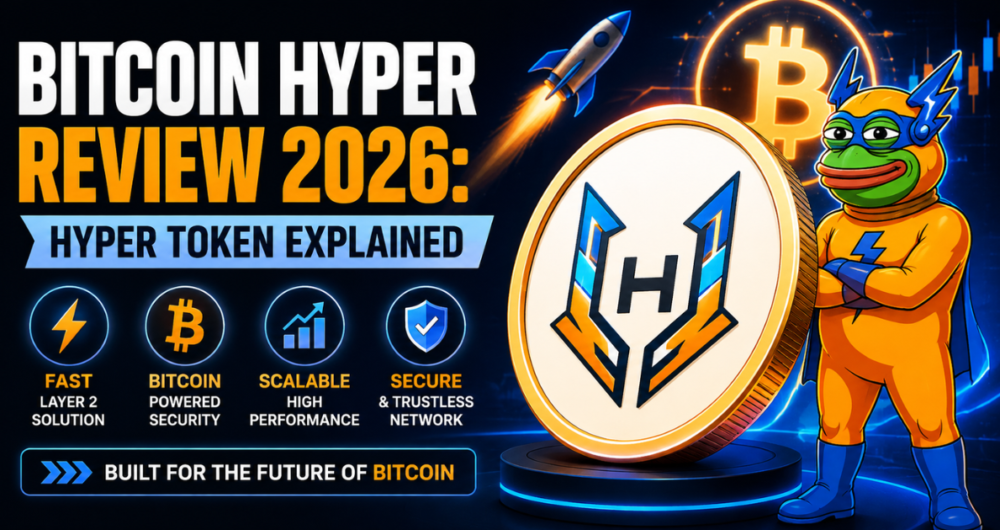
Bitcoin Hyper is attracting attention because it combines two powerful crypto narratives: Bitcoin scaling and high-speed programmable blockchains. The project presents itself as a Bitcoin Layer 2 designed to make BTC transactions faster and cheaper while supporting decentralized finance, staking, payments, and decentralized applications. Its native asset is the HYPER token. However, the technology remains an early-stage proposition rather than something investors should automatically treat like Bitcoin itself.
That distinction matters. Despite its name, Bitcoin Hyper is not Bitcoin, does not represent ownership of Bitcoin, and should not be confused with BTC. The project’s own terms state that purchasing its tokens does not provide ownership or another interest in a company or entity. For anyone researching Bitcoin Hyper crypto, the useful question is therefore not simply whether the idea sounds promising, but whether the technology, security, liquidity, development, and token economics justify its risks.
What Is Bitcoin Hyper and the HYPER Token?
Bitcoin Hyper describes itself as a Bitcoin Layer 2 network intended to add capabilities that are difficult to provide directly on Bitcoin’s base blockchain. According to the project, users would be able to move BTC into its Layer 2 environment and use it for faster transfers, decentralized exchanges, staking, payments, and other blockchain applications. The project says its execution environment uses the Solana Virtual Machine, commonly abbreviated as SVM.
The HYPER token has a different role from the BTC that would move through the proposed network. The project describes HYPER as its native token for network transactions, staking, governance, and ecosystem participation. That means buying HYPER is not another method of buying Bitcoin. Investors are taking exposure to a separate crypto asset whose value would depend heavily on execution, adoption, liquidity, token demand, and the wider cryptocurrency market.
Bitcoin vs. Bitcoin Hyper
| Feature | Bitcoin | Bitcoin Hyper |
|---|---|---|
| Native asset | BTC | HYPER |
| Main purpose | Decentralized digital asset and settlement network | Proposed Bitcoin Layer 2 and application ecosystem |
| Execution model | Bitcoin base layer | Project proposes SVM-based execution |
| Smart-contract focus | Limited compared with programmable chains | Designed for DeFi and dApps |
| Investment history | Established market and long operating history | Early-stage, highly speculative project |
| Relationship | Original Bitcoin network | Separate project intended to interact with Bitcoin |
The comparison exposes one of the most important misconceptions surrounding the project. The word “Bitcoin” in the brand does not mean the token inherits Bitcoin’s track record, liquidity, decentralization, or security automatically. Layer 2 systems introduce additional software, bridges, contracts, operators, and economic assumptions. Each component creates dependencies that need to work correctly before users can safely rely on the resulting ecosystem.
The project also openly uses meme-coin language. Its official website includes a disclaimer identifying the asset as a meme coin while simultaneously presenting utility goals for a Bitcoin Layer 2. That combination deserves attention. A token may have proposed utility while still trading primarily on speculation during its early stages. Buyers should therefore separate what exists today from features described in roadmaps, development posts, or promotional materials.
How Does the Bitcoin Hyper Layer 2 Work?
The proposed system starts with a Canonical Bridge. According to the project, a user sends BTC to a designated Bitcoin address. A Bitcoin Relay Program operating in its SVM environment verifies Bitcoin block headers and transaction proofs. After verification, a corresponding representation of BTC is created on the Layer 2, where it can supposedly move faster and interact with applications without requiring every action to be processed directly on Bitcoin’s base layer.
Transactions conducted on this Layer 2 are intended to be batched and compressed. The project says zero-knowledge proofs would establish transaction validity before Layer 2 state information is periodically committed to Bitcoin Layer 1. When users want their original BTC back, they initiate a withdrawal, the relevant proof is checked, and the bridge releases BTC to the user’s Bitcoin address. These are project-described mechanics rather than a guarantee of real-world security or performance.
Why the Solana Virtual Machine Matters
SVM is central to the project’s pitch because it aims to provide a high-throughput execution environment capable of supporting more complex applications. Bitcoin Hyper’s development materials say the runtime is intended to support Solana-style programs and developer workflows while using Bitcoin for settlement. The broader vision is to create an application layer where developers could build wallets, finance tools, social applications, exchanges, payment systems, and other decentralized services.
Development updates published by the project discuss a devnet, native SVM programs, execution-layer research, sequencing models, infrastructure services, indexing, monitoring, bridges, and a path toward decentralization. Those posts indicate ongoing development activity, but readers should distinguish project-published progress reports from independently verified production performance. A devnet or technical roadmap does not by itself demonstrate that a mainnet can securely hold substantial user funds under real-world conditions.
A useful way to understand the concept is to imagine Bitcoin as the settlement foundation and the proposed Hyper network as an additional execution environment. Users would perform more frequent or complicated actions outside Bitcoin’s normal transaction path and periodically rely on cryptographic commitments to connect the resulting state back to Bitcoin. Whether that architecture delivers its intended benefits ultimately depends on successful implementation of the bridge, proofs, sequencing, data availability, and withdrawal mechanisms.
Bitcoin Hyper Presale, Tokenomics, and Staking
As of August 14, 2026, the project’s official website continued to describe the HYPER presale as live. At the time it was checked, the page displayed a token price of $0.0337. However, the same live interface showed its fundraising counter as “$0 / $0,” illustrating why dynamic presale widgets should not be treated as permanent financial records. Prices, stages, totals, and sale conditions can change and should always be rechecked directly.
The project’s terms provide another important detail: presale buyers may not receive tokens immediately. The terms state that buyers accept that they may need to wait until the presale concludes before receiving purchased assets. They also describe payments through third-party processors or blockchain systems and state that staked tokens become claimable seven days after the project’s claim function goes live. Those conditions create liquidity and execution risks that normal spot-market buyers may not face.
HYPER Tokenomics
The project’s published allocation is:
| Allocation | Share | Stated Purpose |
| Development | 30% | Layer 2 development |
| Treasury | 25% | Business development and community activity |
| Marketing | 20% | Paid and organic promotion |
| Rewards | 15% | Staking and community rewards |
| Listings | 10% | Exchange-listing allocation |
These figures show that 30% is assigned to development while 20% is assigned to marketing. Token allocation alone does not determine whether a project will succeed. Investors should also look for vesting schedules, unlock dates, circulating supply, treasury controls, wallet concentration, liquidity arrangements, and rules governing any project-controlled allocations. The official allocation should therefore be treated as the start of tokenomics research rather than the end of it.
The project currently describes HYPER staking as another token use case. Staking rewards may sound attractive, but a percentage yield should never be evaluated independently from token-price risk. Receiving more units of a rapidly depreciating asset can still leave a holder with a substantial dollar loss. Buyers should also establish which contracts control staking, when withdrawals become available, whether rewards create additional supply, and whether those contracts have undergone appropriate security testing.
For readers searching how to buy Bitcoin Hyper, the official process currently involves connecting a compatible crypto wallet, choosing an accepted payment method, entering the desired amount, and confirming the transaction. The site also offers a buy-and-stake option. Wallet connections and token presales create phishing and contract risks, so users should verify the exact website, network, transaction permissions, and contract information rather than following links received through social media or direct messages.
Bitcoin Hyper Price and Price Prediction
Searching for the Bitcoin Hyper price produces a surprisingly messy picture. Different cryptocurrency websites currently display dramatically different figures for assets using the Bitcoin Hyper or HYPER name. Meanwhile, CoinCarp associates the audited Ethereum contract with a fixed total supply of 21 billion HYPER but says it does not currently have reliable exchange-price data for that asset. This creates a serious token-identification problem for anyone relying on a ticker symbol alone.
The official presale website displayed $0.0337 per HYPER when reviewed on August 14, 2026, but that figure is a presale-stage price rather than proof of what an unrestricted secondary market would value the token at. Once a token becomes freely tradable, buyers and sellers determine market prices. Liquidity, circulating supply, exchange availability, sell pressure, market sentiment, Bitcoin’s performance, development progress, and actual network usage can all influence the outcome.
What Could Influence HYPER’s Future Value?
Potential price drivers include:
- Successful launch and reliable operation of the Layer 2
- A secure and usable Bitcoin bridge
- Real developer and dApp adoption
- Exchange liquidity and accessible trading markets
- HYPER token utility inside the network
- Token unlocks and circulating-supply growth
- Staking participation and reward emissions
- Bitcoin and broader crypto-market conditions
- Security incidents or technical failures
- U.S. and international regulatory developments
Any Bitcoin Hyper price prediction that publishes an exact 2027, 2030, or 2040 target should therefore be treated as a scenario rather than a forecast with measurable certainty. Even major price platforms use simple percentage-growth calculators for some long-range crypto projections. Such calculations do not prove that a network will gain users, generate sustainable demand, avoid exploits, secure exchange liquidity, or maintain a particular valuation.
A better framework is scenario analysis. A positive case would require working infrastructure, credible security, developer adoption, liquid markets, and genuine demand for HYPER. A neutral case could involve a functioning project that struggles to gain meaningful adoption. A negative case could involve delayed development, weak liquidity, token dilution, technical problems, or fading speculative interest. None of those outcomes can be reliably converted into an exact dollar price today.
Is Bitcoin Hyper Legit? Audits, Risks, and Due Diligence
The answer requires more nuance than either “yes” or “scam.” There is a real website, published technical material, token contracts, development updates, and third-party smart-contract audits. Coinsult lists an audit for a Bitcoin Hyper Ethereum token contract, while SolidProof published a security assessment for the project. Those are legitimate due-diligence data points, but an audit should never be interpreted as proof that an entire project is safe or commercially viable.
SolidProof’s own report makes the limitation explicit. It says its review covered only one Bitcoin Hyper token contract, did not include functional or unit testing of the contract’s logic, and did not audit other contracts associated with the project. That distinction is critical because a complete Layer 2 may depend on bridges, staking systems, sequencers, proofs, infrastructure, and other components beyond a simple ERC-20 token contract.
The project’s legal terms also acknowledge a high degree of risk and significant potential token-price fluctuations. Those terms identify Sentinum Ltd. in the British Virgin Islands and state that the purchase does not give buyers ownership in a company or entity. The official materials reviewed also provide considerably more information about the technology than about individually named founders or executives, meaning team transparency should remain part of any serious due-diligence process.
Major Risks to Consider
A serious Bitcoin Hyper review should account for:
- Presale and token-delivery risk
- Mainnet execution risk
- Bridge and smart-contract vulnerabilities
- Limited operating history
- Liquidity and exchange-listing uncertainty
- Token-price volatility
- Staking-contract risk
- Token unlock and supply pressure
- Project-team transparency
- Phishing and fake-token impersonation
- Regulatory uncertainty
- Dependence on continued developer and user adoption
U.S. readers should also avoid assuming that the term “meme coin” creates regulatory approval or protection. A 2025 SEC Division of Corporation Finance staff statement said certain meme coins fitting its description generally do not involve securities transactions, but it explicitly said the analysis depends on the specific facts and that its statement is not a Commission rule or blanket determination. It also noted that purchasers of such meme coins may lack federal securities-law protections.
The SEC’s Investor.gov site separately warns that different crypto assets can carry very different risks and that fraudsters frequently use crypto assets, fake platforms, impersonation, and misleading claims to target investors. Wallet security matters as well: users should never reveal private keys or seed phrases and should be especially cautious with links that request wallet connections or transaction approvals.
There is also a tax angle for U.S. participants. The IRS treats digital assets as property for federal income-tax purposes, and taxpayers are responsible for reporting applicable income, gains, and losses. Reporting requirements have continued to develop, including Form 1099-DA rules for digital-asset brokers. Anyone actively buying, selling, exchanging, or earning crypto rewards should maintain accurate transaction records rather than waiting until tax season to reconstruct them.
Conclusion
Bitcoin Hyper presents an ambitious idea: combine Bitcoin settlement with a faster SVM-based execution environment capable of supporting payments, DeFi, staking, and decentralized applications. Its published architecture, tokenomics, development updates, and contract audits give researchers concrete material to evaluate. At the same time, proposed utility should not be confused with proven adoption, production-grade security, deep liquidity, or the long operating history associated with Bitcoin itself.
For potential buyers, the strongest approach is verification rather than prediction. Check the actual contract, current presale conditions, security scope, network status, liquidity, token supply, and project execution before making a decision. Bitcoin Hyper could develop into a functioning Bitcoin-focused ecosystem, or it could struggle to achieve meaningful adoption. At this stage, its future depends far more on what the project successfully builds and secures than on optimistic price targets circulated online.
Frequently Asked Questions
Is Bitcoin Hyper the same as Bitcoin?
No. Bitcoin is the established blockchain and cryptocurrency whose native asset is BTC. Bitcoin Hyper is a separate crypto project proposing a Layer 2 environment that interacts with Bitcoin. HYPER is its own token and does not represent ordinary BTC ownership. The project says BTC would instead be bridged into its Layer 2 environment for faster transactions and application use.
Is Bitcoin Hyper a Layer 2?
The project describes itself as a Bitcoin Layer 2 built around an SVM-based execution environment, zero-knowledge proofs, a Canonical Bridge, and periodic commitments to Bitcoin Layer 1. Its development pages discuss a devnet and ongoing rollup research. However, prospective users should independently verify current mainnet availability, security architecture, bridge implementation, decentralization, and production performance rather than treating the “Layer 2” label itself as proof of those characteristics.
What is the HYPER token used for?
According to the project, HYPER is intended to support transactions, staking, governance, rewards, and participation within the network’s ecosystem. The published token allocation assigns 30% to development, 25% to treasury purposes, 20% to marketing, 15% to rewards, and 10% to listings. Actual long-term token demand will depend on whether the network launches successfully and attracts users, developers, liquidity, and useful applications.
Is Bitcoin Hyper a good investment?
There is no objective answer that applies to every investor. It is an early-stage crypto project with substantial technology, liquidity, execution, bridge, token, and market risks. Its own terms explicitly warn that purchasing HYPER involves a high degree of risk. Contract audits provide useful information but do not prove that the broader Layer 2 ecosystem is secure or that the token will appreciate.
Where can you buy Bitcoin Hyper?
The project’s official website currently describes its presale as live and provides wallet-based purchase options. Binance states that HYPER cannot currently be purchased directly with a debit or credit card on the Binance Exchange, although wallet-based decentralized methods may differ by region and asset. Because similarly named HYPER tokens appear on multiple tracking services, buyers should independently verify the official network and contract before signing any wallet transaction.