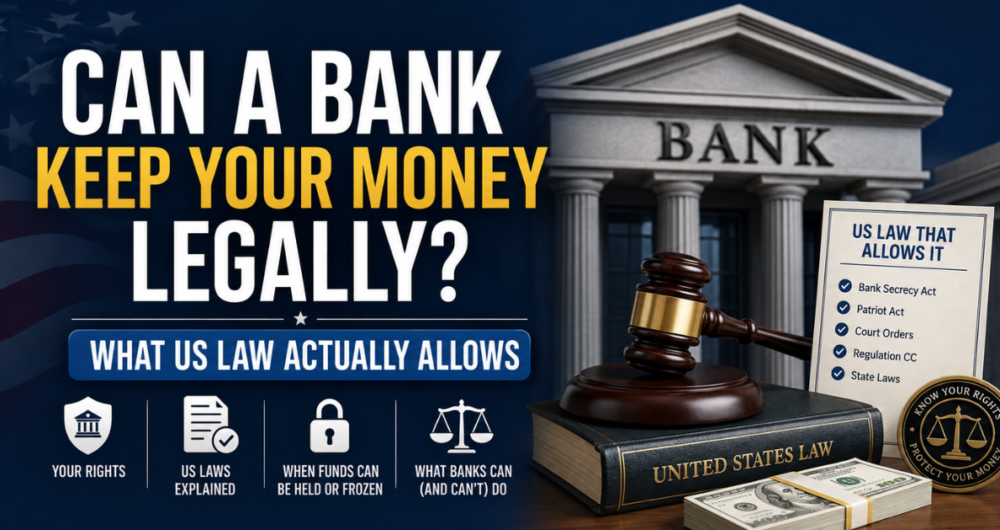
No — a bank cannot permanently keep your money just because it wants to. But under specific legal circumstances, a bank can legally hold, freeze, or take money from your account temporarily or permanently. This includes new-deposit holds under federal regulation, the “right of offset” for unpaid debts owed to that same bank, court-ordered garnishments, tax levies, and fraud or anti-money-laundering investigations. Outside of these narrow situations, your deposits remain your property, and federal insurance (FDIC for banks, NCUA for credit unions) protects them up to $250,000 per depositor, per institution.
The rest of this guide breaks down exactly when a bank is allowed to hold your money, how long each type of hold can last, and what to do if you believe a bank is keeping your money illegally.
Your Money Legally Belongs to You — With One Technical Twist
When you deposit cash into a bank account, ownership of that specific cash technically transfers to the bank, and the bank records a matching liability — a debt it owes back to you on demand. That’s why banks can lend out deposited funds while still guaranteeing that you can withdraw your balance whenever you want. In practical, legal terms, this distinction rarely matters to everyday customers: your account balance is still treated as your money, protected by consumer banking law, and the bank is obligated to give it back to you on request unless one of the exceptions below applies.
When a Bank CAN Legally Hold or Take Your Money
1. Standard Deposit Holds (Regulation CC)
The most common reason people ask “can a bank keep your money legally” is a simple deposit hold. Federal rules under Regulation CC, which implements the Expedited Funds Availability Act (EFAA), set maximum timeframes for when deposited funds must become available. In general, <cite index=”12-1″>a bank or credit union’s cut-off time for receiving deposits can be no earlier than 2:00 p.m. at physical locations and no earlier than noon at an ATM or elsewhere, and banks may hold deposits for more than one business day under certain conditions.</cite>
As of the CFPB’s 2025 inflation adjustment, <cite index=”12-1″>amounts up to $5,525 generally must be available within two business days for a local check, while amounts over that threshold are typically available within seven business days.</cite> Under the broader Reg CC framework, <cite index=”15-1″>funds from most local checks must be made available by the second business day following the day of deposit, with only minor exceptions.</cite>
Banks are also required to be upfront about this. <cite index=”11-1″>Banks must post their funds availability policies in branches and on ATMs, and must notify customers of any changes to those policies at least thirty days before the change takes effect.</cite>
2. Exception Holds (Large, New, or Suspicious Deposits)
Banks can extend a hold beyond the standard schedule in specific, disclosed situations. <cite index=”11-1″>Longer holds are permitted for new accounts, unusually large deposits, or when fraud is suspected — but only if the bank’s policy discloses that exception to the customer at the time of the hold.</cite> A deposit generally counts as “large” once it crosses roughly $6,000–$7,000 in a single day, and that threshold adjusts for inflation every five years.
If a bank decides to hold your funds longer than its general policy allows, it isn’t free to do so silently. <cite index=”15-1″>The institution must give you a notice at the time of deposit explaining why the funds are being held and when they will become available, and if the hold decision comes after the deposit, the notice must be delivered no later than the next business day.</cite>
3. The Bank’s “Right of Offset”
This is one of the most misunderstood legal powers banks hold. If you owe the bank money — for example, on a car loan, personal loan, or credit card issued by that same institution — the bank may, in some circumstances, pull funds directly from your checking or savings account to cover the debt. <cite index=”3-1″>Banks have the ability to take money they are owed for loans, such as car loans, mortgages, or personal loans, using this right of offset, but only under certain circumstances tied to an existing debt relationship.</cite>
This power typically only applies within the same bank. <cite index=”3-1″>If you hold both a mortgage and deposit accounts with the same institution and fall behind on payments, that bank can use the right of offset to recover the shortfall directly from your checking, savings, or CD balance, and this right is usually spelled out in the account agreement you sign when you open the account.</cite>
Importantly, this right has limits. <cite index=”8-1″>The right of offset generally doesn’t apply to every type of debt — for instance, a bank typically cannot use offset to recover an unpaid credit card balance issued through that bank, though a credit union’s agreement may grant broader offset rights depending on what you signed.</cite> Reading your account agreement carefully before signing is the only reliable way to know your specific exposure.
4. Court Orders, Judgments, and Garnishments
A bank can freeze or turn over your funds if legally compelled to by a court. This usually starts when a creditor sues you and wins. <cite index=”8-1″>If you fall behind on a debt and the creditor takes you to court and wins a judgment, that creditor can request a lien on your bank account, and only once the bank has that court order in hand can it freeze or withdraw the funds.</cite>
Banks don’t have discretion here — they must comply. <cite index=”4-1″>Banks are required to comply with legal orders such as a tax levy, a judgment, or a court-ordered garnishment.</cite>
5. Tax Levies
Unpaid federal or state taxes are one of the few situations where a government body can reach directly into your account, but even this comes with warnings first. <cite index=”6-1″>The government generally cannot take money out of your bank account unless you have an unpaid tax bill, and even then it typically sends several notifications and offers multiple chances to pay before resorting to a levy.</cite> By contrast, ordinary consumer debts or unpaid child support don’t let a government agency reach into your account directly — <cite index=”6-1″>instead, the government permits other parties, like private creditors through the court system, to pursue the funds.</cite>
6. Suspected Fraud or Illegal Activity
Banks aren’t just permitted to freeze suspicious accounts — they’re required to. <cite index=”8-1″>A bank has a legal obligation to freeze an account if it suspects fraud or other illegal activity, and it doesn’t have to warn you in advance, even though that can result in bounced payments or lost interest on funds pulled from savings or a CD.</cite> Once the bank completes its investigation and rules out wrongdoing, <cite index=”8-1″>the account is unfrozen.</cite>
This is also tied to anti-money-laundering compliance. <cite index=”9-1″>Large or unusual deposits may trigger a review under anti-money-laundering rules, and institutions may also delay funds during routine account maintenance or liquidity management.</cite>
7. Locked-In Account Terms (CDs, GICs, Term Deposits)
If you voluntarily opened an account with a maturity date — a certificate of deposit or similar term product — the bank is within its rights to restrict access until that date. <cite index=”7-1″>Accounts with locked-in terms, such as certificates or long-term savings products, come with conditions requiring funds to remain in the account until maturity, based on the agreement signed when the account was opened.</cite> This isn’t the bank “keeping” your money unfairly — it’s the terms you agreed to, usually in exchange for a higher interest rate. Early withdrawal is often still possible, just with a penalty.
What a Bank CANNOT Legally Do
It’s just as important to know where the line sits. A bank cannot:
- Keep your money indefinitely with no explanation or legal basis
- Refuse a legitimate withdrawal simply because it doesn’t want to process it
- Apply an exception hold without disclosing the reason and expected release date
- Use the right of offset against funds that are legally exempt (such as certain federal benefit payments)
- Seize funds from an account at a different institution without first winning a court judgment and garnishment order
<cite index=”5-1″>A bank generally cannot directly access funds you hold at a different financial institution to settle a debt unless it follows the legal process of obtaining a judgment and garnishment order, which requires a court process that gives you the chance to challenge the seizure.</cite>
And the bottom line on ordinary holds: <cite index=”2-1″>a bank can legally refuse to hand over your money for a while and in specific situations, such as placing a hold on a fresh deposit or freezing an account tied to suspected fraud or a court order — but what it cannot do is keep the money outright, since it remains yours and stays FDIC-insured up to the coverage limits.</cite>
How Federal Insurance Protects You
Even when a bank fails or becomes insolvent, your money isn’t simply gone. <cite index=”5-1″>FDIC-insured banks protect deposits up to $250,000 per account holder, per bank, and account holders with balances above that limit can reduce risk by spreading funds across multiple institutions or using instruments like Treasury bonds or money market funds.</cite> Credit union deposits carry equivalent protection through the National Credit Union Administration (NCUA).
What To Do If You Think a Bank Is Illegally Withholding Your Money
- Ask for the hold notice in writing. The bank is required to state the reason for any exception hold and the date funds will be released.
- Check your account agreement. Look specifically for right-of-offset language and any CD or term-deposit clauses you may have agreed to.
- Call the bank’s compliance or escalation line. Front-line staff often can’t override a hold, but a supervisor or compliance officer can explain or sometimes expedite it.
- File a complaint with the Consumer Financial Protection Bureau (CFPB) at consumerfinance.gov if the bank won’t explain the hold or release funds within the legally required window.
- Contact the OCC, NCUA, or your state banking regulator, depending on whether you’re dealing with a national bank, a credit union, or a state-chartered bank.
- Get legal help for larger disputes, especially garnishments, tax levies, or account freezes tied to fraud investigations — an attorney can review whether exempt funds (like Social Security or disability payments) were improperly seized.
Frequently Asked Questions
Can a bank hold your money for no reason?
No. Every hold — whether a standard deposit hold or an exception hold — must have a disclosed, regulation-backed reason and a defined release date.
How long can a bank legally hold your money?
For most local check deposits, funds must generally be available within two business days, and within seven business days for larger amounts, under current Regulation CC thresholds. Exception holds (new accounts, large or suspicious deposits) can extend this further, but the bank must notify you why.
Can a bank take money from your account without permission?
Only under the right of offset for a debt owed to that same bank, a court-ordered garnishment, a tax levy, or a fraud investigation — not for any other reason.
Can a bank keep your money if you owe them?
Yes, but generally only through the right of offset for debts owed to that specific bank, and typically not for products like credit cards issued through the same bank, depending on your account agreement.
Is my money safe if my bank fails?
Yes, up to $250,000 per depositor, per FDIC-insured bank (or NCUA-insured credit union).
Bottom Line
So, can a bank keep your money legally? Only temporarily, and only under specific, regulated circumstances — deposit holds, the right of offset, court orders, tax levies, or fraud investigations. Outside those situations, your funds remain your property, protected by federal law and deposit insurance. If a bank withholds your money without a valid, disclosed reason, you have clear paths to challenge it — starting with a written explanation from the bank and escalating to a formal regulatory complaint if needed.
This article is for general informational purposes only and is not legal or financial advice. Banking regulations and account agreements vary, so consult a licensed attorney or your account disclosures for guidance specific to your situation.