Shopping for a loan or credit card can feel like reading a foreign language. Lenders throw around percentages, fees, and terms that all sound similar but mean very different things. That’s where APR comes in. It’s the one number designed to give you the full picture of what borrowing actually costs.
Knowing how to calculate APR formula on your own puts you in control. You stop relying on a lender’s marketing and start comparing offers with real numbers. This guide breaks the formula down into plain English, walks through a worked example, and shows you exactly how APR shifts across credit cards, personal loans, and mortgages.
What Is APR and Why It Matters
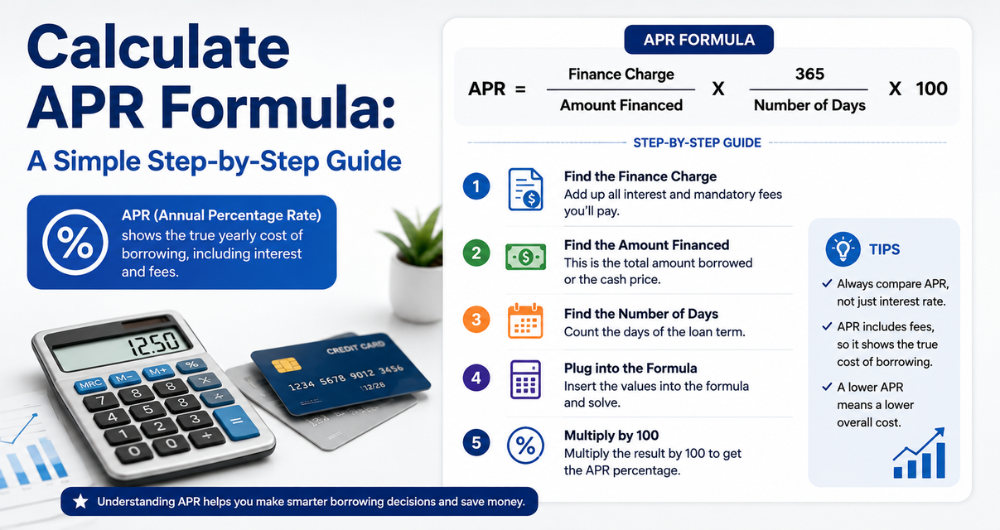
APR stands for Annual Percentage Rate. It represents the yearly cost of borrowing money, expressed as a percentage. Unlike a simple interest rate, APR wraps in certain fees and charges tied to the loan, giving you a more complete view of what you’ll actually pay over time.
Lenders are required by federal law to disclose APR, which makes it one of the most reliable tools for comparing offers. A loan with a lower interest rate but high fees can end up costing more than a loan with a slightly higher rate and no fees. APR levels that playing field so you’re comparing true costs, not just advertised numbers.
APR vs Interest Rate
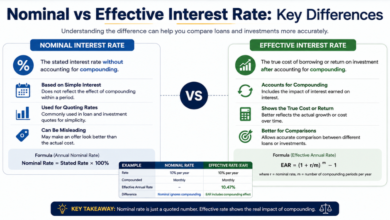
People often use these terms interchangeably, but they measure different things. The interest rate only reflects the cost of borrowing the principal amount. APR goes further and factors in additional costs like origination fees, mortgage points, or certain closing costs.
| Feature | Interest Rate | APR |
|---|---|---|
| Includes lender fees | No | Yes |
| Reflects true borrowing cost | Partially | Fully |
| Used for monthly payment math | Yes | Rarely directly |
| Best for comparing loan offers | No | Yes |
| Required disclosure by law | Yes | Yes |
Because APR includes more variables, it’s almost always slightly higher than the stated interest rate. If the two numbers are identical, that’s usually a sign the loan carries few or no additional fees.
The Calculate APR Formula Explained
Once you understand what APR represents, the math behind it becomes much easier to follow. The formula isn’t as intimidating as it looks once you know what each part stands for and where the numbers come from on your loan documents.
The Basic APR Formula
The standard formula lenders use looks like this:
APR = ((Fees + Interest) / Principal / Number of Days in Loan Term) x 365 x 100
This formula converts your total borrowing cost, including fees, into an annualized percentage. It’s designed to normalize loans of different lengths and structures so you can compare them side by side, regardless of whether one is a 12-month personal loan or a 30-year mortgage.
Breaking Down Each Variable
Each piece of the formula plays a specific role in the final percentage:
- Fees: Origination fees, closing costs, or mortgage points added to the loan
- Interest: The total dollar amount of interest paid over the loan term
- Principal: The original amount borrowed before fees or interest
- Number of Days: The full length of the loan term in days
- 365: Used to annualize the rate regardless of the loan’s actual length
Understanding these variables helps you see why two loans with the same interest rate can have very different APRs. The fee amount alone can shift the final percentage significantly, especially on shorter-term loans.
How to Calculate APR Formula Step by Step
Calculating APR by hand is straightforward once you have the right numbers in front of you. Most lenders will provide these figures in your loan estimate or disclosure documents, so you’re mainly plugging numbers into the formula rather than hunting for data.
Follow these steps:
- Gather your total fees, including origination charges and closing costs
- Add up the total interest you’ll pay over the full loan term
- Divide the combined fees and interest by the principal amount
- Divide that result by the total number of days in the loan term
- Multiply the result by 365 to annualize it
- Multiply by 100 to convert the decimal into a percentage
Here’s a quick worked example. Say you borrow $10,000 with $300 in fees, $1,200 in total interest, and a 365-day term.
((300 + 1200) / 10000 / 365) x 365 x 100 = 15%
That 15% APR reflects the full cost of borrowing, not just the advertised interest rate, which might have been listed closer to 12%.
Calculate APR Formula for Different Loan Types
The core formula stays the same, but the inputs change depending on what you’re financing. Fees, terms, and compounding structures vary widely across credit cards, personal loans, and mortgages, which is exactly why APR is so useful for apples-to-apples comparisons.
Credit Cards
Credit card APR usually excludes upfront fees and instead reflects the interest rate applied to unpaid balances. Because interest compounds daily on most cards, your effective cost can be higher than the stated APR if you carry a balance month to month.
Card issuers typically list a range, such as 18.99% to 27.99% APR, depending on your creditworthiness. Paying your statement balance in full each month means you avoid interest entirely, making APR less relevant day-to-day but still important when comparing card offers.
Personal Loans
Personal loans often include origination fees deducted from the loan amount before you receive it. This makes APR noticeably higher than the interest rate alone. A loan advertised at 9% interest might carry an APR closer to 11% once a 3% origination fee is factored in.
Always ask lenders for the APR upfront rather than relying solely on the interest rate. Two personal loan offers with identical rates can have very different total costs once fees are added into the calculation.
Mortgages
Mortgage APR calculations are the most complex because they include points, mortgage insurance, and various closing costs spread across a much longer term. A small difference in APR on a 30-year mortgage can translate into thousands of dollars over the life of the loan.
Because mortgage terms are so long, even fractional APR differences matter significantly. Comparing the APR, not just the interest rate, across multiple lender estimates is one of the most effective ways to avoid overpaying on a home loan.
APR vs Other Rate Terms (Comparison Table)
Borrowers frequently confuse APR with related terms like APY or the nominal interest rate. This table clears up the differences so you know exactly which number to look at for each purpose.
| Term | What It Measures | Includes Fees | Best Used For |
|---|---|---|---|
| Interest Rate | Cost of borrowing principal | No | Estimating monthly payments |
| APR | Annualized cost including fees | Yes | Comparing loan offers |
| APY | Annualized return including compounding | N/A (savings) | Comparing savings accounts |
| Effective Rate | True cost after compounding | Sometimes | Advanced loan analysis |
Common Mistakes When You Calculate APR Formula
Even careful borrowers slip up when working through APR calculations. Small errors in the inputs can lead to a misleading final percentage, which defeats the purpose of using APR to compare offers in the first place.
Watch out for these common issues:
- Forgetting to include all applicable fees, not just the origination fee
- Using the wrong number of days for the loan term
- Confusing APR with APY when comparing loans versus savings products
- Assuming a lower interest rate always means a lower APR
- Ignoring variable-rate structures that cause APR to shift over time
Double-checking your inputs against your official loan disclosure is the easiest way to catch these mistakes before they throw off your comparison.
Tools and Tips to Make APR Calculations Easier
You don’t need to do this math by hand every time. Plenty of free online APR calculators exist, and most loan disclosure documents already show the calculated APR for you. Still, understanding the formula helps you verify those numbers instead of taking them at face value.
Use this checklist before finalizing any loan or credit decision:
- Confirm the APR listed matches the fees and interest you were quoted
- Compare APR, not just interest rate, across multiple lenders
- Check whether the APR is fixed or variable
- Factor in the loan term length when comparing total cost
- Ask the lender to itemize every fee included in the APR calculation
Conclusion
Learning to calculate APR formula gives you a real advantage when borrowing money. It strips away marketing language and shows you the true annual cost of a loan, fees and all. Whether you’re comparing credit cards, personal loans, or mortgage offers, the same core formula applies, even as the inputs shift.
Next time you’re evaluating a loan offer, don’t stop at the interest rate. Take a few minutes to calculate APR formula yourself, or at least verify the number your lender provides. That small step can save you real money over the life of the loan.
Frequently Asked Questions
What is a good APR rate?
A good APR depends on the loan type and your credit profile, but generally, anything below the national average for that product category is considered favorable. Comparing multiple offers is the best way to know if a rate is competitive.
Is APR the same as interest rate?
No. Interest rate reflects only the cost of borrowing the principal, while APR includes additional fees, giving you a more complete picture of the loan’s true annual cost.
How is APR calculated on a credit card?
Credit card APR is typically based on the interest rate applied to unpaid balances, often compounded daily. It usually doesn’t include upfront fees the way loan APRs do.
Does a lower APR always mean a cheaper loan?
Usually, yes, since APR already accounts for fees. However, always check the loan term length too, since a longer term can increase total interest paid even at a lower APR.
Can I negotiate my APR?
In some cases, yes. Improving your credit score, offering collateral, or shopping multiple lenders can help you secure a lower APR before finalizing a loan.