

If you’ve ever read a financial news headline about the Federal Reserve raising rates by “25 basis points,” you’ve probably wondered what that actually means in plain English. Basis points show up everywhere in finance, from mortgage rates to bond yields to investment fees, yet most people never learn how to calculate basis points on their own.
The good news is that once you understand the formula, basis points become one of the easiest financial concepts to work with. This guide walks you through exactly what basis points are, why they matter, and how to calculate basis points step by step using real numbers you can apply right away.
By the end, you’ll be able to convert basis points to percentages, calculate percentages to basis points, and confidently read financial reports without second-guessing yourself.
You don’t need a finance background to follow along. This guide breaks everything down into plain language, real dollar examples, and simple tables you can reference later. Whether you’re comparing mortgage offers, reading about the stock market, or studying for a finance certification, the basis points formula you learn here will apply the same way every time.
What Are Basis Points?
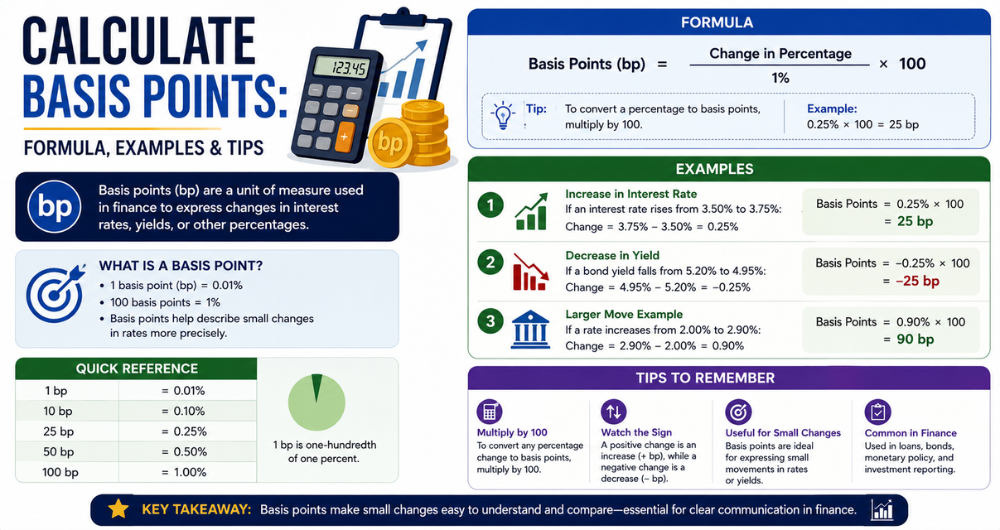
A basis point, often abbreviated as “bps” and pronounced “bips,” is a unit of measurement used in finance to describe small changes in interest rates, bond yields, and other financial percentages. One basis point equals one hundredth of one percent, or 0.01%. This tiny unit helps professionals avoid confusion when discussing precise rate movements.
Financial experts prefer basis points over plain percentages because percentages can be ambiguous. Saying “rates rose by 1%” could mean different things depending on context, but saying “rates rose by 100 basis points” removes all doubt. This precision is exactly why basis points calculation matters so much in banking, investing, and lending.
Basis points scale in a simple, predictable way. Since 1 basis point equals 0.01%, it takes 100 basis points to equal 1%. This relationship is the foundation of every basis points formula you’ll use, so keep it in mind as you move through the rest of this guide.
The term originated in bond trading, where investors needed a standardized way to compare yields between different securities without confusing decimal points. Over time, the same unit spread into mortgage lending, corporate finance, and everyday financial journalism, becoming the universal shorthand for small, precise rate movements across nearly every corner of the financial world.
Why Basis Points Matter in Finance
Basis points aren’t just industry jargon. They directly affect how much you pay on loans, how much you earn on investments, and how funds report performance. Understanding how to calculate basis points gives you a clearer picture of your own financial decisions.
Here’s where basis points show up most often:
- Mortgage and auto loan interest rates
- Federal Reserve rate announcements
- Bond yields and fixed-income investments
- Mutual fund and ETF expense ratios
- Credit card APR changes
- Corporate financial reporting and forecasting
Even a small movement of 25 or 50 basis points can translate into thousands of dollars over the life of a mortgage. That’s why lenders, investors, and analysts rely on basis points instead of rounded percentages when precision genuinely matters.
Consider a $300,000 mortgage. A rate difference of just 50 basis points, or half a percent, can shift your monthly payment by tens of dollars and your total interest paid over 30 years by several thousand dollars. When you learn how to calculate basis points, you gain the ability to quickly estimate that impact yourself instead of relying entirely on a lender’s disclosure documents.
The Basis Points Formula Explained
The basis points formula is refreshingly simple once you see it laid out. There are two directions you’ll typically calculate: converting a percentage into basis points, and converting basis points back into a percentage.
To convert a percentage to basis points:
Basis Points = Percentage × 100
To convert basis points to a percentage:
Percentage = Basis Points ÷ 100
That’s the entire basis points formula. Because 1% always equals 100 basis points, multiplying or dividing by 100 is all you ever need to do. No complicated math, no special calculator required — just a consistent conversion factor you can memorize in seconds.
It helps to think of basis points as a zoomed-in version of percentages. Just as inches let you measure more precisely than feet, basis points let you measure interest rates and yields more precisely than whole percentages. This is especially useful when analysts discuss changes smaller than a quarter of a percent, where rounding to the nearest percentage point would erase meaningful detail from the conversation.
How to Calculate Basis Points Step by Step
Let’s put the formula into action with a few practical examples so the process feels intuitive rather than abstract.
Example 1: Converting a percentage to basis points
Suppose an interest rate increases from 4% to 4.5%. Here’s how to calculate basis points for that change:
- Find the difference in percentage: 4.5% − 4% = 0.5%
- Multiply by 100: 0.5 × 100 = 50
- The rate increased by 50 basis points
Example 2: Converting basis points to a percentage
Suppose a bond yield rises by 75 basis points. To find the percentage change:
- Take the basis points value: 75
- Divide by 100: 75 ÷ 100 = 0.75
- The yield increased by 0.75%
Example 3: Calculating a dollar amount using basis points
Basis points also apply to fees and loan balances. If a $200,000 loan carries a 1% origination fee described as 100 basis points, here’s the calculation:
- Convert basis points to a decimal: 100 bps ÷ 10,000 = 0.01
- Multiply by the loan amount: $200,000 × 0.01 = $2,000
- The fee equals $2,000
Notice that step one divides by 10,000 instead of 100 when applying basis points directly to a dollar figure. This is because basis points represent hundredths of a percent, and percentages themselves are already divided by 100 to become decimals.
Example 4: Comparing two savings accounts
Say Bank A offers a savings rate of 4.10% and Bank B offers 3.85%. To calculate basis points for the difference:
- Find the difference: 4.10% − 3.85% = 0.25%
- Multiply by 100: 0.25 × 100 = 25
- Bank A pays 25 basis points more than Bank B
On a $10,000 balance, that 25 basis point gap translates to roughly $25 more in annual interest, which shows how quickly small basis point differences add up when larger sums of money are involved.
Basis Points vs Percentage: Key Differences
Percentages and basis points measure the same underlying concept, but they serve different purposes depending on how much precision a situation requires.
| Feature | Basis Points | Percentage |
|---|---|---|
| Smallest unit | 0.01% | 1% (typically) |
| Common use | Interest rates, bond yields, fees | General comparisons, everyday math |
| Precision | High — avoids rounding confusion | Lower — can be ambiguous |
| Example | 25 bps | 0.25% |
| Industry preference | Banking, finance, investing | Retail, general communication |
Choosing between the two comes down to context. A retailer might describe a 5% discount using plain percentages, while a bond trader would describe the same-sized yield movement in basis points to eliminate any chance of misreading the figure.
Basis Points in Real-World Scenarios
Seeing basis points calculation applied to real financial situations makes the concept click faster than formulas alone. Below are common scenarios where basis points influence real money.
When the Federal Reserve adjusts the federal funds rate, financial media reports the change in basis points because the movements are often small but consequential. A “25 basis point hike” means rates rose by 0.25%, which can ripple through mortgage rates, savings account yields, and credit card APRs within weeks.
Investment fees are another area where basis points calculation matters directly to your wallet. Expense ratios on mutual funds and ETFs are frequently quoted in basis points because the differences, while tiny in percentage terms, add up significantly over decades of compounding.
For example, an index fund charging 15 basis points versus one charging 60 basis points may look like a negligible gap on paper. But on a $100,000 portfolio held for 20 years, that 45 basis point difference can quietly cost tens of thousands of dollars in lost growth, since fees compound against your returns every single year rather than just once.
| Scenario | Basis Points | Percentage Equivalent | Practical Impact |
|---|---|---|---|
| Fed rate hike | 25 bps | 0.25% | Slightly higher borrowing costs |
| Mortgage rate increase | 50 bps | 0.50% | Higher monthly payment |
| Bond yield change | 10 bps | 0.10% | Small price adjustment |
| ETF expense ratio | 15 bps | 0.15% | Lower annual fees than average |
| Loan origination fee | 100 bps | 1.00% | Upfront cost on loan amount |
Use this table as a quick reference when you encounter basis points in financial news or account statements. Matching the bps figure to its percentage equivalent instantly clarifies the real-world impact.
Common Mistakes When Calculating Basis Points
Even simple math becomes confusing under pressure, especially when large numbers or multiple conversions are involved. Here are the mistakes people make most often when learning how to calculate basis points.
- Forgetting that 100 basis points equal 1%, not 10%
- Mixing up the direction of the formula (multiplying instead of dividing)
- Applying the percentage conversion factor instead of the dollar conversion factor
- Rounding too early in multi-step calculations
- Confusing basis points with percentage points in comparative statements
A quick checklist can help you avoid these errors every time you calculate basis points:
- Confirm whether you’re converting percentage-to-bps or bps-to-percentage
- Use ÷100 for percentage conversions and ÷10,000 for dollar conversions
- Double-check your decimal placement before finalizing the answer
- Verify the result makes sense in context (small movements should stay small)
- Re-read the original figure to confirm you copied it correctly
Running through this checklist takes only a few seconds but prevents costly misunderstandings, especially in financial reporting or loan calculations where accuracy really counts.
Do You Need a Basis Points Calculator?
For simple one-off conversions, doing the math by hand is fast and reliable once you know the formula. However, a basis points calculator becomes genuinely useful in specific situations.
Consider using a calculator or spreadsheet formula when you’re working with large batches of numbers, such as comparing dozens of loan offers or analyzing a portfolio of bonds with varying yields. Automating the basis points calculation reduces the risk of manual errors and saves time during detailed financial analysis.
On the other hand, manual calculation works perfectly well for everyday situations like understanding a single mortgage rate change or interpreting a news headline about a Fed rate decision. Since the formula only involves multiplying or dividing by 100, most people can perform it mentally within seconds once they’ve practiced it a few times.
If you do decide to build your own basis points calculator in a spreadsheet, the formula is just as simple as the manual version. A cell formula like =A1*100 converts a percentage in cell A1 into basis points, while =A1/100 converts basis points back into a percentage. Dragging that formula down a column lets you convert dozens of rates at once, which is ideal for comparing multiple loan quotes or fund options side by side.
Conclusion
Learning to calculate basis points doesn’t require a finance degree, just a clear grasp of one simple relationship: 100 basis points always equals 1%. Whether you’re converting a percentage to basis points, translating basis points back into a percentage, or applying basis points to a dollar amount, the same core formula applies every time.
Understanding this concept helps you read financial news with confidence, evaluate loan offers accurately, and compare investment fees like a seasoned professional. The next time you see a headline about basis points, you’ll know exactly what it means and how to calculate basis points yourself, without needing to look it up again.
Frequently Asked Questions
What is one basis point equal to?
One basis point equals 0.01%, or one hundredth of a percent. It takes 100 basis points to equal 1%.
How do you convert basis points to a percentage?
Divide the basis points figure by 100. For example, 150 basis points divided by 100 equals 1.5%.
Why do banks and investors use basis points instead of percentages?
Basis points provide more precision and eliminate ambiguity when describing small rate changes, which is especially important in interest rates, bond yields, and fee structures.
How many basis points are in 1%?
There are always 100 basis points in 1%, regardless of the financial context or industry.
Can basis points be used for dollar amounts, not just rates?
Yes. To apply basis points to a dollar figure, divide the basis points by 10,000 and multiply by the total amount, since this accounts for both the percentage and basis point conversion in one step.
